 Yip Chemical | Masterbatch and Carbon Black Supplier
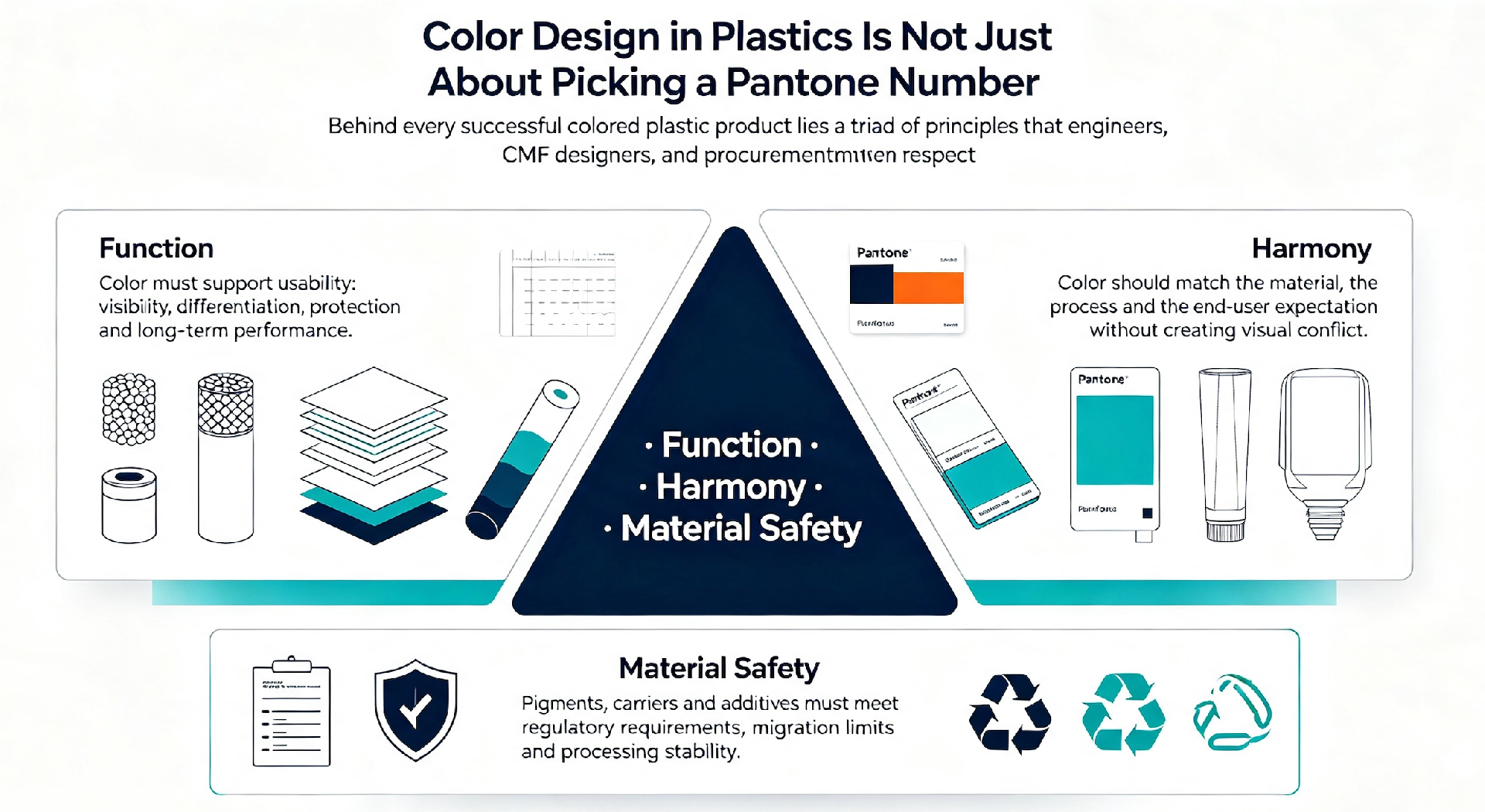
Color design in plastics is not just about picking a Pantone number.
Behind every successful colored plastic product lies a triad of principles that engineers,
CMF designers, and procurement teams must respect: Function, Harmony, and Material Safety.
This article breaks down these three laws — using classic examples from agriculture, packaging, consumer goods,
and automotive — and shows how Carbon Black and Black Masterbatch choices determine whether a "design black"
becomes a "production black."
Law #1: Color Must Serve Function First
Before aesthetics, color must fulfill the product's physical or biological purpose.
Agricultural Mulch Films – A Classic Case
Red film: Carrots grow faster; sugar beets increase sugar content; rice seedlings thrive.
Yellow film: Cucumber yields double; celery and lettuce grow taller and delay bolting.
Black-and-yellow striped film: Tea leaf yield and quality improve.
Blue film: Wheat growth improves, protein content rises.
Green film: Crops suffer — deprived of essential light wavelengths, they grow weakly.
Pharmaceutical packaging: Must block light — achieved by high-concentration Carbon Black in the masterbatch.
Orange dive suits: Highly visible; sharks instinctively avoid the color.
Law #2: Harmony and Comfortable Matching
When function does not dictate color, comfort and environmental harmony take over.
Key Rules of Thumb
Instruments and dashboards must match the overall machine color scheme.
Household items should coordinate with room interior tones.
Hospital environments require soft, quiet, elegant colors; weddings call for warm, joyful palettes.
Color Contrast Wisdom
Complementary colors (e.g., red-green): Strong, jarring — best reserved for small decorative accents only.
Identical hues: Soft but boring — rarely used alone.
Analogous (neighboring) hues: Ideal — gentle, elegant, visually comfortable.
Medium-strength contrasts (red-yellow, yellow-blue, orange-green, purple-green): Great for toys and stationery — lively, clear, eye-catching.
Always Establish a Dominant Tone
Even multi-color products have one dominant hue. Decide the main tone first (warm/cool, light/dark), then adjust secondary tones around it.
Law #3: Pigment Performance Determines Safety and Durability
End-users rarely understand pigment chemistry — but engineers must. Mistakes here cause recalls, failures, or safety hazards.
| Application | Critical Requirement |
| Food containers, cups, lunch boxes, children's toys, medical devices | Non-toxic, FDA/GB 9685, low PAHs, RoHS/REACH |
| Road traffic signs, wire & cable jacketing | Anti-aging, UV-resistant, electrically insulating |
| Microwave-safe containers, steam-cooking trays | Heat resistance up to 200–300°C, no yellowing |
| Automotive bumpers | Toughened, reinforced, wide temperature tolerance |
Why Pre-Dispersed Black Masterbatch Wins Over Raw Carbon Black Powder
No dust, no workshop contamination
Uniform dispersion — no streaks, no surface defects
Batch-to-batch ΔE control within ≤1.0
Can integrate anti-UV, conductive, or food-grade functions in one pellet